
Cover: F-15C Eagle above the Mariana Islands, 18 September 2018. U.S. Air Force / Senior Airman Zachary Bumpus. Original photograph and credit.
A fighter gets the photograph. The aircraft that refuelled it, watched the surrounding airspace and delivered its spare engine usually do not. Yet all of them belong in the same story.
Military aviation is easier to understand when you start with the job rather than the silhouette. An aircraft designed to intercept another aeroplane must solve a very different problem from one built to find a submarine or carry a field hospital. Speed matters enormously in some of those jobs. In others, it is less valuable than endurance, a large cargo door or room for a team of radar operators.
This guide explains the main types of military aircraft, using established designs to show what each role demands. It concentrates on fixed-wing aeroplanes, including remotely piloted examples. Helicopters and tiltrotors add important capabilities, but deserve a guide of their own.
The main roles are air combat, ground attack, bombing, reconnaissance, airborne early warning, electronic warfare, maritime patrol, transport, refuelling and training. These categories overlap: one aircraft may perform several jobs, and an aircraft's role can change as it is developed.
Military aircraft roles at a glance
These are working categories, not rigid boxes. The examples illustrate a purpose; they are not a ranking or a list of every aircraft currently in service.
| Role | Main job | Examples |
|---|---|---|
| Fighter / multirole fighter | Contest airspace; some also attack surface targets | F-15C, F-15E, Typhoon |
| Bomber | Deliver substantial weapon loads, often over long distances | B-52H, B-2 |
| Attack aircraft | Strike surface targets, including support for ground forces | A-10C |
| Reconnaissance / surveillance | Collect imagery and other intelligence | U-2S, MQ-9 |
| Airborne early warning and control | Build an air picture and coordinate operations | E-3 Sentry |
| Electronic warfare | Detect and disrupt hostile electronic systems | EA-18G Growler |
| Maritime patrol | Search for and monitor activity above and below the sea | P-8 Poseidon |
| Transport / tanker | Move people and cargo, or refuel other aircraft | C-17, KC-135 |
| Trainer | Prepare aircrew for more demanding flying | T-38 Talon |
1. Fighters: controlling the air
A fighter's defining task is to counter other aircraft. That may mean defending an area, escorting a formation or intercepting an aircraft that needs to be identified. An interception does not necessarily end in combat: identification and air policing are important military flying tasks in their own right.
The F-15 Eagle is a clear example of a design shaped around air superiority. Its combination of powerful engines and a relatively large wing helps it accelerate and manoeuvre. The US Air Force's technical description specifically links its turning performance to thrust-to-weight ratio and wing loading: how much aircraft weight each unit of wing area must support.
But the wing and engines tell only part of the story. Radar, communications and cockpit displays help the pilot find and understand what is happening beyond the canopy. Reducing a fighter to its top speed misses much of the work it was built to do. Source: USAF F-15 fact sheet.
What makes a fighter “multirole”?
A multirole fighter is equipped for more than one kind of mission, especially air-to-air and air-to-surface work. The F-15E Strike Eagle demonstrates how far a familiar design can develop: its two-seat arrangement and strike systems support air-to-ground missions as well as air combat. It should not be treated as interchangeable with a single-seat F-15C simply because both carry the Eagle name. Source: USAF F-15E fact sheet.
The RAF's Typhoon offers another example. It developed from the air-to-air F Mk2 into the multirole FGR4. The RAF also describes it as swing-role: capable of undertaking contrasting tasks within one sortie. That is a useful distinction. “Multirole” describes the aircraft's range of jobs; “swing-role” emphasises its ability to switch between them during a flight. RAF Typhoon overview; RAF explanation of swing-role operations.
For an unusual chapter in the Eagle's history, see how an F-15 became an anti-satellite launch aircraft.
2. Bombers and attack aircraft: different ways of reaching the ground
The words fighter and bomber suggest a neat division until a fighter drops a bomb. The distinction becomes clearer when you ask what the aircraft was optimised to carry, how far it must travel and how it is expected to survive.
A heavy bomber devotes substantial space and weight to fuel and weapons. The B-52H is a long-range, subsonic example. Its history also shows why “bomber” does not mean one unchanging method of attack: the aircraft has used both bombs and air-launched missiles, and the USAF lists missions ranging from strategic attack to close air support. Later sensors and weapons can change what an old airframe is useful for without changing its recognisable outline. Source: USAF B-52 fact sheet.

Stealth changes the approach, not the job
The B-2 takes a different approach to reaching defended targets. Its flying-wing shape, materials and coatings contribute to low observability. The USAF describes efforts to reduce several signatures, including radar and infrared, rather than a single device that makes the aircraft disappear. That is why stealth is a characteristic, not a separate mission category: it can be part of a bomber or a fighter. Source: USAF B-2 fact sheet.
Why the A-10 looks so different
The A-10 was designed specifically for close air support of ground forces. Its priorities included manoeuvrability at low speeds, time near the battle area and survivability. The titanium protection around its pilot and redundant flight-control arrangements reflect those priorities. They are deliberate answers to the mission, rather than evidence that the aircraft belongs to an earlier stage of jet design.
Its cannon is famous, but the A-10C can also employ guided weapons. Focusing only on the gun obscures the broader task of finding and attacking surface targets in support of people on the ground. Source: USAF A-10C fact sheet.
3. Reconnaissance aircraft: bringing back information
A reconnaissance flight is valuable because of what it discovers. The useful load may be cameras and sensors rather than weapons, and the important performance figure may be time at altitude rather than maximum speed.
The U-2 makes that trade-off visible. Its long, slender wings give it glider-like characteristics. The U-2S carries equipment for collecting imagery and signals intelligence, with sensor options that include electro-optical and infrared cameras and synthetic-aperture radar. These are different ways of observing the world, not simply different zoom settings on one camera.
Its landing procedure provides an unusually vivid glimpse of the demands of specialised design: another U-2 pilot normally follows in a high-performance car, giving the landing pilot information about height and runway alignment. An aeroplane built for prolonged work at great altitude still has to negotiate the last few feet above a runway. Source: USAF U-2 fact sheet.
Where do drones fit?
“Drone” tells you very little about the mission. The MQ-9 Reaper combines intelligence collection with strike capabilities. Its system includes the aircraft, a ground control station, communications links and the people who operate and maintain it. The basic operating crew includes a pilot and a sensor operator.
Calling it unmanned therefore means that nobody is sitting inside the aircraft; it does not mean nobody is flying it. Nor does it make reconnaissance a new category. Remotely piloted aircraft carry out jobs that also exist in crewed aviation, using a different arrangement for putting people in control. Source: USAF MQ-9 fact sheet.
4. Airborne early warning: seeing the larger picture
An E-3 Sentry looks like an airliner carrying a huge disc. The disc houses its radar, but describing the aircraft as a flying radar station leaves out the people beneath it.
The E-3's mission crew performs surveillance, identification, communications and battle-management work. The aircraft gathers information about other aircraft and ships, presents it to operators and shares it with other parts of the force. It can help direct fighter aircraft, making it an example of an aeroplane whose influence extends beyond its own flight path.
AWACS means Airborne Warning and Control System. The “control” deserves as much attention as the “warning”: detecting something and helping others respond to it are related but different tasks. Source: USAF E-3 fact sheet.

5. Electronic warfare: a mission you cannot read from a photograph
Some aircraft are designed to interfere with the electronic systems on which other forces depend. The EA-18G Growler is an airborne electronic-attack aircraft developed from the two-seat F/A-18F Super Hornet. Receivers and jamming equipment make it more than a fighter with a different designation.
The distinction from reconnaissance is helpful. Listening for or identifying a signal collects information; electronic attack seeks to disrupt an adversary's use of the electromagnetic spectrum. The same broad field can involve both. A useful description must explain which task is meant instead of treating every aircraft with an antenna as a “spy plane”. Source: NAVAIR EA-18G overview.
The role also predates the Growler. The EF-111A Raven served as a tactical jamming aircraft during the 1980s and 1990s. Its electronic warfare officer concentrated on the jamming equipment, illustrating how a specialised mission can reshape the work inside an otherwise familiar airframe. Source: National Museum of the USAF.
6. Maritime patrol: searching a very large ocean
A maritime patrol aircraft has to find useful information in a setting where distance and concealment dominate. A vessel may be far from land; a submarine may be below the surface. Simply arriving quickly over the sea does not solve either problem.
The RAF's Poseidon MRA1 is equipped to detect, identify and monitor contacts above and below the water. Sonobuoys are part of its submarine-search capability, and it can carry torpedoes. That combination explains why maritime patrol overlaps reconnaissance and combat: the aircraft can investigate a contact as well as carry a means of attacking a submarine.
Its outward resemblance to a passenger aircraft should not obscure its purpose. The specialised equipment and the work of its crew matter more than whether the fuselage looks immediately “military”. Source: RAF description of Poseidon's capabilities.
7. Transport aircraft: the importance of the cargo door
Put a transport aircraft beside a fighter and it is tempting to compare speed. Start with the cargo instead. How large is it? Can it fit through the opening? Can it be loaded efficiently, secured safely and delivered to the available airfield?
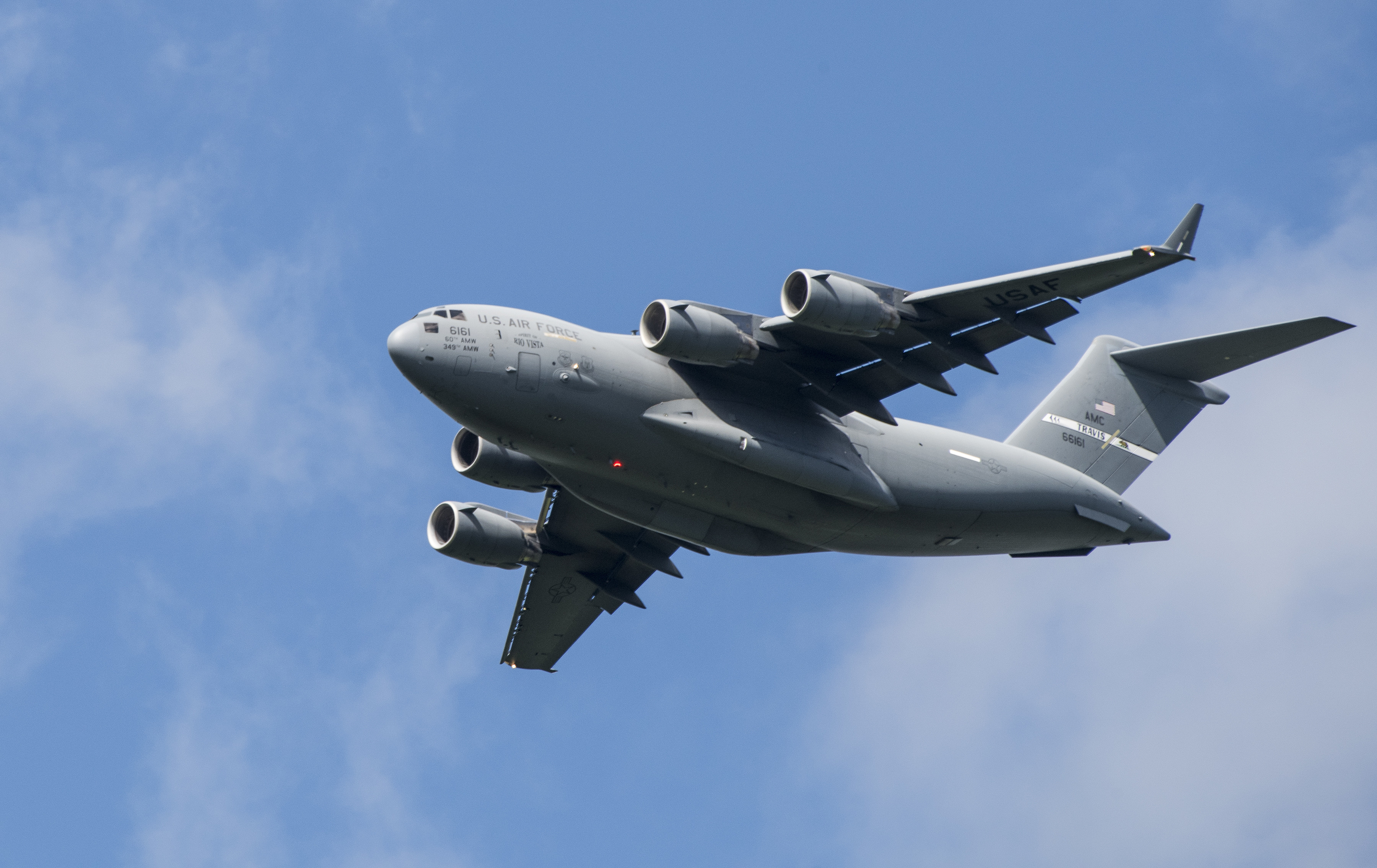
The C-17 Globemaster III has a large rear ramp and a cargo floor that can be configured for vehicles or palletised loads. The same aircraft can carry troops, deliver cargo by air or support aeromedical evacuation. Its design combines long-distance transport with the ability to use relatively short, austere airfields.
“Strategic” and “tactical” airlift describe different demands, but the C-17 illustrates why the categories can overlap. Moving a load across a continent and delivering it closer to where it is needed are connected parts of the same logistical problem. Source: USAF C-17 fact sheet.
8. Tankers: carrying fuel for somebody else
A tanker makes a seemingly simple exchange possible: one aircraft passes fuel to another while both remain airborne. The consequences are substantial. A receiving aircraft can continue a journey or spend longer on its task without immediately returning to land.
The KC-135's principal transfer system is a flying boom controlled by a boom operator. Probe-equipped aircraft use a different connection: a hose-and-drogue arrangement, in which the receiving aircraft's probe meets a trailing basket. The KC-135 can use a drogue adapter, and some examples have additional refuelling pods.
Compatibility matters. “Can be refuelled in the air” is not enough to establish that any tanker can refuel any receiver in any configuration. The physical equipment has to match. The KC-135 also has space for passengers and cargo, another reminder that aircraft categories describe primary purposes rather than exclusive ones. Source: USAF KC-135 fact sheet.
9. Trainers: learning before the front line
A trainer is judged by how well it prepares a person for the next stage of flying. That makes visibility, instruction, operating demands and the cockpit's equipment important parts of its design.
The T-38 Talon is a supersonic jet trainer with student and instructor sitting in tandem. Training has included formation flying, aerobatics, instrument work and navigation. The T-38C's electronic cockpit displays show how a training aircraft can be adapted to the systems students will encounter later.
Two seats alone do not identify a trainer: the second person in a combat aircraft may be a weapons or mission specialist. Equally, a trainer is not necessarily slow. The label describes why the aircraft is being flown. Source: USAF T-38 fact sheet.
How to read a military aircraft's design
The next time you see an unfamiliar aircraft, ask three questions before looking up its speed.
What must it carry?
A fighter's weapons, a reconnaissance aircraft's sensors and a transport's cargo impose different requirements. Look at the doors, external pods and overall proportions. They are clues, although a photograph cannot reveal everything inside.
Where must it operate?
A high-altitude reconnaissance flight and a delivery to a small airfield place different demands on an aircraft. The U-2's wing and the C-17's loading arrangements make more sense when viewed as answers to those demands.
What does it need from other aircraft?
The bomber refuelling photograph above is a useful corrective to the idea of an aircraft acting alone. Fuel, information and transport connect the roles described here. A fleet's capability cannot be understood by counting its most dramatic-looking jets and ignoring everything around them.
Common questions about military aircraft
What is the difference between a fighter and a bomber?
A fighter is principally associated with countering other aircraft; a bomber is designed around delivering weapons against surface targets, often with an emphasis on payload and range. Multirole fighters can also attack the ground, so carrying bombs alone does not make an aircraft a dedicated bomber.
Are all military aircraft armed?
No. Training, airlift and refuelling are military tasks without requiring every aircraft to carry offensive weapons. The USAF lists no armament for the T-38A/C, for example. Mission and configuration matter more than the military markings.
Why do military aircraft still use propellers?
Propellers can be well suited to efficient flight at lower speeds. A turboprop uses a gas turbine to drive a propeller; it is not simply a surviving piston-engine technology. NASA's propulsion guide explains why turboprops are used in lower-speed transport applications, while faster transports commonly use turbofans. The choice reflects the required performance rather than a universal hierarchy of “old” and “new”. Source: NASA, Turboprop Thrust.
Does stealth mean invisible?
No. Low-observable design seeks to make an aircraft more difficult to detect, track and engage. It does not make it physically invisible. The B-2's design reduces several signatures, and “stealth” should not be read as an unconditional guarantee against detection.
Is a drone a separate type of military mission?
No. Remotely piloted describes how an aircraft is operated. Reconnaissance and strike describe what it does. The MQ-9 is an example of an aircraft that combines both missions without carrying its operating crew on board.
A better way to understand military aviation
The most revealing question about an aircraft is often the simplest: what problem was it built to solve? Follow that question and a long wing, an ungainly radar dome or a cavernous cargo hold starts to look less mysterious.
It also makes aviation history more interesting. Designs change because the work changes, and familiar aircraft acquire unexpected second lives. Explore more of those stories in our aircraft and history archive, including the Arado Ar 234 and the early jet bomber.
Sources and photography
Aircraft-specific facts are linked to official US Air Force, US Navy, RAF, NASA and museum sources throughout the guide. Examples explain established roles; they are not a statement of current fleet numbers, readiness or retirement schedules.
All four photographs, including the cover, are credited US Air Force images sourced from official fact sheets. They are used as public-domain US government imagery for editorial illustration. AF.mil's reuse guidance requests appropriate photo credits. Their inclusion does not imply US Department of Defense endorsement of this website.
 Vengeance And Fury: The Air Force’s Uncrewed Fighters Take Shape
 The Focke-Wulf Fw 189 Uhu: The "Flying Eye" of the Eastern Front
 The F-15 Eagle and the Anti-Satellite Missile: When a Fighter Jet Reached for Space